
Pet Dental Health Month
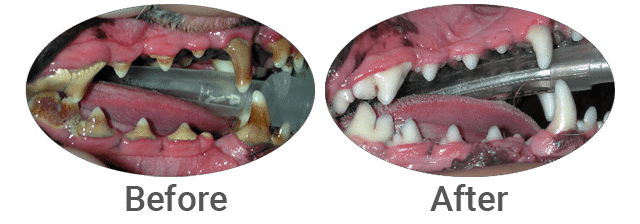
In honor of Pet Dental Health Month, the team at Hôpital Vétérinaire Métro Iberville invites all pet owners to pay special attention to their cats' and dogs' teeth.
Dental disease is the most common health problem in domestic pets. According to the Quebec Veterinary Medical Association, 80% of dogs and 70% of cats over 3 years old suffer from some form of dental disease. It can cause serious health problems and affect your pet's well-being.
What is Dental Disease?
(Periodontal Disease)
Dental disease is usually silent. When it begins, there are no external signs or visible symptoms. However, once the disease progresses, it can wreak havoc in your pet's mouth, causing chronic pain, eroded gums, missing teeth, and bone loss.
Dental disease affects the areas around your pet's teeth, including the gums, soft tissues, and even the jawbone. It's a bacterial infection that manifests in four stages:
Stage 1: Gingivitis
You may notice bad breath, tartar buildup on the teeth, and slight redness of the gums.
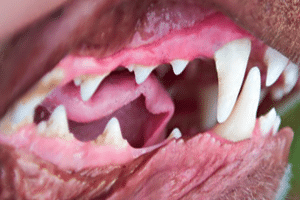
Stage 2: Early Periodontal Disease
You may notice more pronounced bad breath, more discolored and tartar-covered teeth, and redness of the gums.
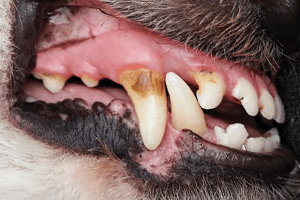
Stage 3: Moderate Periodontal Disease
You may notice very bad breath, significant tartar buildup especially on the molars, very stained or discolored teeth, and pronounced gum redness. Your pet may chew more on one side than the other.
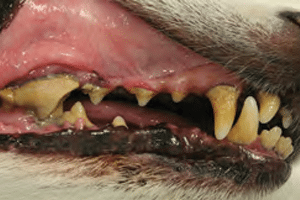
Stage 4: Advanced Periodontal Disease
You'll notice severe bad breath (extreme halitosis), and your pet may show signs of pain, such as being reluctant to have their head touched or dropping kibble while chewing.
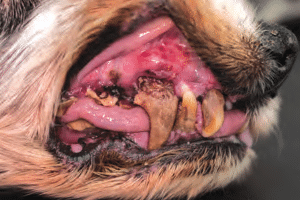
Gum disease is about five times more common in pets than in humans due to the chemical composition of cats' and dogs' mouths and saliva. Additionally, their mouths are more alkaline, which allows for greater plaque formation.
Symptoms of Dental Disease
Here are some signs to watch for to recognize dental disease in your companion:
- Inflamed or red gums
- Bad breath
- Discolored teeth or tartar buildup
- Excessive drooling or blood in saliva
- Loss of appetite or weight loss
- Difficulty chewing or eating
- Loose or broken teeth
- Oral pain
- Reluctance to open mouth
- Inactivity, decreased family interactions
Most of the time, we don't realize our pets are suffering from periodontal disease until it reaches an advanced stage. This is mainly because early symptoms are difficult to detect.
If you regularly check your pet's teeth and mouth, the first visible sign of disease is inflamed gums. Another early sign of periodontal disease is sudden, strong bad breath. Your pet's teeth may also appear yellow or brown. In more advanced cases, you may notice that your pet has loose or even missing teeth, loss of appetite, chronic oral pain, and personality changes.
One complication of dental disease is pathological jaw fracture. When left untreated, dental disease weakens your pet's jawbone to the point where even minimal pressure could result in a complete fracture.
In addition to gum and mouth problems, untreated dental disease can lead to an increased risk of:

Heart Disease

Kidney Disease

Liver Problems
What Causes Dental Disease in Cats and Dogs?
Bacteria are the main cause of periodontal disease in pets (and humans). The most common bacteria are Actinomyces and Streptococcus. As soon as your pet eats something, bacteria break down the food, saliva, and other particles to form a thick film on the teeth. This is called plaque.
Plaque does many things, such as providing bacteria with a favorable environment to multiply and grow. Plaque can also mix with minerals in saliva to form tartar. Tartar is harder to remove than plaque and adheres firmly to your pet's teeth, but tartar itself is not a sign of periodontal disease.
When there's plaque buildup, your pet's immune system sends white blood cells to try to eliminate or neutralize the bacteria.
The bacteria then signal the white blood cells to release enzymes that break down the gums. This gradual breakdown eventually affects the soft tissues and bones around your pet's mouth.
Diagnosis and Treatment of Dental Disease
If you suspect your pet is suffering from dental disease, your veterinarian can perform a complete oral examination. Once the disease is diagnosed, a dental treatment plan will be created.
The prognosis for dental disease is generally good, although it depends on the stage your pet has reached. That's why you should try to see your veterinarian as soon as you notice something's wrong.
A dental treatment plan consists of a procedure under anesthesia allowing your veterinary team to perform a complete mouth cleaning and extraction of roots affected by dental disease.
What's Included in Our Dental Treatment Plan
A complete and safe veterinary dental procedure includes much more than just a teeth cleaning. Discover all the services included in our dental package to ensure your companion's health and well-being.
Comprehensive Pre-Operative Examination
Before any dental procedure, we perform a detailed physical examination of your pet. Our veterinary team evaluates the heart, lungs, body temperature, and lymph nodes to ensure your companion is healthy and ready to safely undergo anesthesia.
Why it's essential:Your pet can't tell us if they're not feeling well. This thorough examination allows us to detect any hidden health problems that could complicate the procedure, thus ensuring your companion's maximum safety.
Pre-Anesthetic Blood Work
A blood sample is taken and analyzed in our in-house laboratory to check your pet's vital functions, including kidneys, liver, blood sugar, and blood proteins. These results allow us to evaluate your pet's ability to metabolize anesthesia.
Why it's essential:Anesthesia is filtered by the liver and kidneys. If these organs aren't functioning optimally (which is impossible to detect with the naked eye), anesthesia can become risky. This blood test allows us to adjust our anesthetic protocol according to your pet's specific needs, minimizing risks and ensuring their safety.
General Anesthesia and Continuous Monitoring
Your pet is intubated (a tube is placed in their trachea) and kept asleep with precisely dosed gas anesthesia. A qualified animal health technician continuously monitors all your companion's vital signs: electrocardiogram (ECG), blood oxygen level, blood pressure, and respiratory rate, minute by minute.
Why it's essential:Unlike humans who can stay awake at the dentist, pets must be completely asleep for their safety and comfort. Intubation protects their airways from bacteria and water used during cleaning. Continuous monitoring allows our team to react immediately to any change in your pet's condition, ensuring safe anesthesia from start to finish.
Intravenous Fluid Therapy
An intravenous catheter is placed and fluids are continuously administered throughout the procedure and recovery period. This fluid therapy helps maintain stable blood pressure and good hydration throughout anesthesia.
Why it's essential:Anesthesia tends to lower blood pressure. Intravenous fluids maintain optimal blood flow to vital organs, especially the kidneys and brain. Additionally, this fluid therapy helps your pet wake up faster and in better shape after the procedure, reducing post-anesthetic fatigue.
Complete Digital Dental X-rays
We take high-quality digital X-rays of the root of each of your pet's teeth. These images allow us to see what's happening below the gum line, where the majority of dental problems develop.
Why it's essential:What you see in your pet's mouth represents only 40% of the tooth - 60% is below the gum, invisible to the naked eye. Without X-rays, we could miss infections, abscesses, or diseased teeth that continue to cause pain and health problems. X-rays allow us to accurately assess the condition of each tooth and make the best treatment decisions for your companion.
Ultrasonic Scaling, Polishing, and LASER Therapy
We perform a complete cleaning with an ultrasonic scaler that removes tartar and plaque on and below the gum line. Then, we polish each tooth to smooth the enamel and reduce plaque reaccumulation. Finally, we apply Laser Therapy treatment to the gums to promote healing.
Why it's essential:Ultrasonic scaling effectively removes hardened tartar that brushing cannot eliminate. Polishing creates a smooth surface that slows future plaque buildup. Laser therapy is advanced technology that significantly reduces gum inflammation and pain after cleaning, accelerating healing and allowing your pet to eat comfortably the same evening.
For a personalized treatment plan adapted to your pet's specific needs, don't hesitate to contact us at 514-223-1197.
Pet Dental Health Month - February 2026
Book your dental consultation this month. Because healthy teeth today mean a healthier, happier pet for years to come.
Book My Dental Appointment